Sri Lanka is a small island in the grand geography of the world, roughly the size of Ireland or the state of West Virginia, and yet it contains within its modest borders an astonishing concentration of wildlife, ecosystems, and natural spectacle. This is a country where you can watch a leopard stalk through dry scrubland in the morning, spot blue whales from a boat in the afternoon, and fall asleep listening to the sound of a jungle river in the evening. For anyone who loves the natural world, Sri Lanka is not just a destination. It is a revelation.
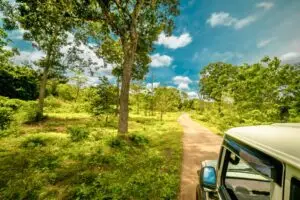
The national parks of Sri Lanka are among the finest and most accessible wildlife areas in Asia, and none is more celebrated than Yala, in the island’s dry south-east. Yala has one of the highest densities of leopards of any national park in the world, a fact that sounds like a tourism brochure claim until the moment your jeep rounds a bend and one of these magnificent cats is lying in a tree not twenty metres away, regarding you with the absolute indifference of an apex predator. Leopards in Yala have grown relatively accustomed to vehicles, which means sightings, while never guaranteed, are more frequent and longer-lasting than in many other leopard habitats. Beyond the leopards, Yala is home to elephants, sloth bears, crocodiles, sambar deer, and a bird list that will keep any birder busy for days. The landscape itself is compelling, a mosaic of scrub jungle, rocky outcrops, lagoons, and stretches of coastline where sea turtles come ashore to nest.
For elephants specifically, Minneriya and Kaudulla national parks in the Cultural Triangle offer one of Asia’s great wildlife spectacles. During the dry season, when water sources across the region shrink, hundreds of elephants gather around the Minneriya tank, a vast ancient reservoir built by a king fifteen centuries ago, to drink, bathe, and socialise. This event, known locally as The Gathering, can involve several hundred elephants at once, moving in family groups across the open plain as the sun goes down and the water turns gold. It is the kind of scene that makes you feel the world is still large and wild and generous.
The ocean around Sri Lanka is equally extraordinary. The waters off Mirissa and Trincomalee are among the most reliable places on Earth to see blue whales, the largest creatures to have ever existed. Between November and April, whale watching boats leave from Mirissa in the early morning and most trips encounter at least one blue whale, often surfacing close enough that you can hear the explosive exhale of its blow. Sperm whales, spinner dolphins, and occasionally orca are also spotted in these waters. It is an experience of profound scale – standing on a small boat in the middle of a vast ocean, watching an animal the length of a tennis court breathe and it stays with you.
Sri Lanka’s smaller natural wonders deserve equal attention. The island sits on a major bird migration route and is home to over 240 species, including 33 species found nowhere else on earth. The wet-zone rainforests of Sinharaja, a UNESCO World Heritage Site, harbour endemic species of birds, butterflies, reptiles, and amphibians that exist in a web of interdependence so complex that scientists are still mapping it. Walking through Sinharaja with a knowledgeable guide is an immersion in biological complexity – layers of forest, every surface covered in moss, lichen, and flowering plants, the air thick with moisture and sound.
The marine world rewards exploration, too. The reefs around Pigeon Island near Trincomalee are among the healthiest coral ecosystems in the country, teeming with reef fish, sea turtles, and the occasional blacktip reef shark. Sea turtle nesting beaches can be found along much of the southern and eastern coastline, and responsible watching programs allow visitors to observe this ancient ritual without disturbing it.
What makes Sri Lanka’s natural world particularly special is how accessible it all is. The country is compact enough that you can move between very different ecosystems in a matter of hours. A morning game drive in the dry zone can be followed by an afternoon on a whale watching boat, which can be followed by a night in a jungle lodge listening to the calls of creatures you may never see but will always remember. Sri Lanka does not ask you to choose between its wonders. It offers them all, close together, in a country that seems almost impossibly rich for its size.