If you want to truly understand a place, you have to eat it. This is especially true in Sri Lanka, where food is not just sustenance but an entire philosophy of life, an expression of the island’s geography, its history of spice trade, its religious diversity, and the particular genius of generations of home cooks who turned a handful of ingredients into something magnificent. Travelling through Sri Lanka without exploring its food culture would be like visiting Florence without seeing its art. You would come home with an incomplete picture of somewhere very full.
The foundation of Sri Lankan cuisine is rice, and this is worth saying plainly because in Sri Lanka, rice is not simply a side dish or a filler. It is the anchor of every meal, the quiet constant around which everything else arranges itself. The country grows dozens of varieties, each with its own texture and flavour, and the choice of rice for a particular dish is taken seriously. A plate of red rice with dhal, a tangle of sauteed greens, a spoonful of pol sambol, the coconut relish that appears at almost every table, and perhaps a piece of fried fish or a curry made with jak fruit represents an everyday meal that is nutritionally complete, economically accessible, and quietly delicious.
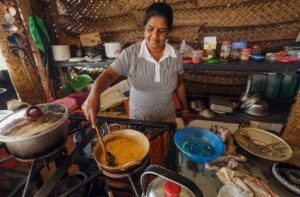
The curries of Sri Lanka deserve their own extended celebration. Unlike Indian curries, which they superficially resemble, Sri Lankan curries tend to be darker, drier, and more intensely roasted in flavour. The spice blends, known as curry powder, are dry-roasted before use, giving them a depth and smokiness that are entirely distinctive. A chicken curry prepared in a clay pot in a village kitchen, cooked slowly over a wood fire with pandan leaf, lemongrass, and a generous pour of thick coconut milk, achieves a richness that no amount of restaurant approximation can fully replicate. The fish curries of the coastal areas, made with the morning’s catch and soured with the dried rind of the goraka fruit, are extraordinary, balancing heat, acidity, and sweetness in proportions that feel instinctively right.
Street food in Sri Lanka is an education in itself and one of the most enjoyable ways to spend time in any town. Kottu roti, arguably the country’s most beloved street food, is made by chopping flatbread on a hot griddle together with vegetables, egg, and your choice of meat or fish. The rhythmic clanging of the metal blades doing the chopping is the sound of Sri Lankan evenings, a culinary percussion that floats out of roadside stalls and into the warm night air. Hoppers, or appa, are bowl-shaped rice-flour crepes, crispy at the edges and soft at the centre, eaten plain with coconut sambol or with an egg cracked into the middle as they cook. String hoppers – delicate nests of steamed rice-flour noodles are a breakfast staple across much of the island, piled on a plate and eaten with coconut milk gravy and lunu miris, a fiery sambol of red onion and chilli that wakes you up more effectively than any cup of coffee.
Speaking of which, Sri Lanka’s tea deserves its reputation. The hill country around Nuwara Eliya and the Uva province produces teas of remarkable character – bright, brisk, and aromatic in ways that the bagged tea of supermarket shelves only hints at. Drinking a freshly brewed cup of Ceylon tea at a plantation bungalow, looking out over terraced fields in the morning mist, is one of those experiences that imprints itself permanently on your memory. The tea culture extends to the dozens of small tea boutiques found along every road in the hill country, where you can stop, pay almost nothing, and drink something that tastes like the landscape itself.
Sweets and desserts in Sri Lanka reflect the island’s layered cultural history. Watalappam, a coconut custard scented with kithul jaggery and cardamom, is a legacy of the Malay community that settled in Sri Lanka centuries ago. Kavum, deep-fried rice flour and treacle cakes made for festivals, carry the flavours of celebration. Curd, the thick, tangy buffalo milk yoghurt served in clay pots, eaten with a spoonful of dark kithul treacle is one of those combinations so perfectly calibrated it seems less like an accident of tradition and more like deliberate genius.
Eating your way through Sri Lanka is not just a pleasure. It is a way of meeting the island on its own terms, of understanding something about the generosity and creativity of its people. The table in Sri Lanka is always being laid for one more person, and you are always welcome at it.